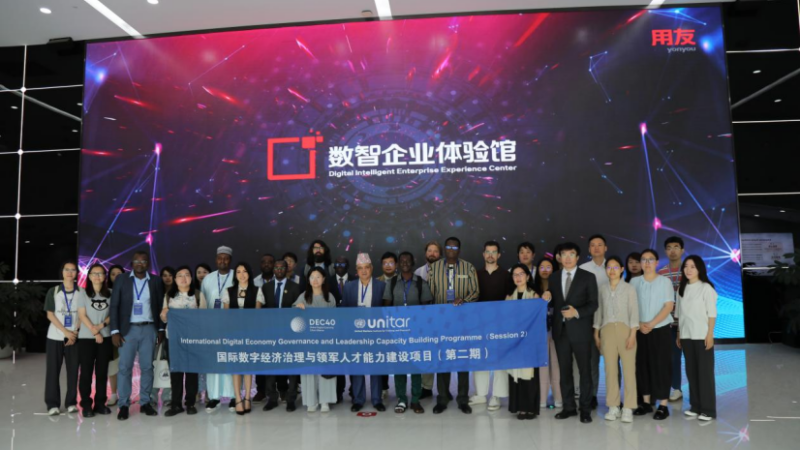
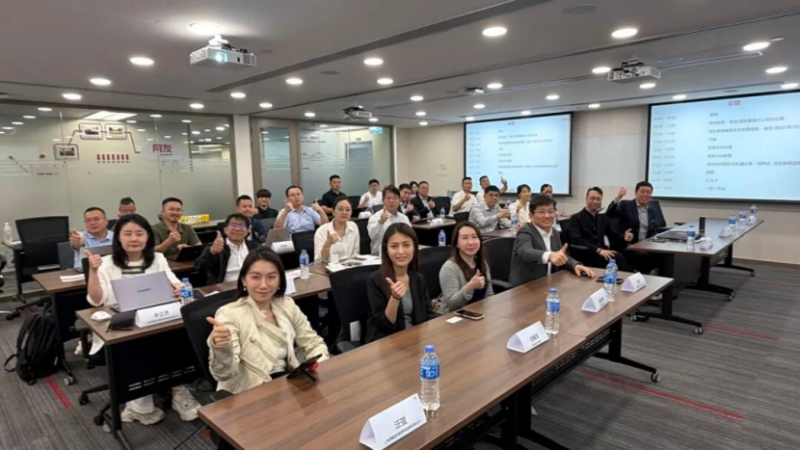
Recently, with the aim of providing an in-depth interpretation of the financial digital and intelligent transformation needs of central and state-owned enterprises (SOEs) and accelerating the implementation of Digital Resource Platforms (DRP), Yonyou, in collaboration with the Beijing National Accounting Institute, hosted the inaugural “Seminar on Best Practices in Financial Digital and Intelligent Transformation and Penetrating Supervision for Central and State-Owned Enterprises” at Yonyou Industrial Park (Beijing). Themed “Achieving Tangible Results Through Penetration, Creating Value with AI,” the seminar brought together participants to explore DRP implementation pathways and jointly address the challenges of penetrating supervision.
During the seminar, the White Paper on DRP and Penetrating Supervision for Central and State-Owned Enterprises, along with a full-scenario solution suite, was officially released. The White Paper aims to systematically articulate the intrinsic logic and integration pathways between DRP and penetrating supervision, while providing an in-depth analysis of its implementation framework, core capabilities, and key application scenarios. Drawing on Yonyou’s practical experience in serving the digital and intelligent transformation of central and state-owned enterprises, it offers both theoretical guidance and practical references for these enterprises as they build a DRP-centric penetrating supervision system. This endeavour serves to safeguard the security and value preservation and appreciation of state-owned assets, thereby injecting strong momentum into the realisation of Chinese-style modernisation.

01 Policy Drivers Establish DRP and Penetrating Supervision as Core Tasks in SOE Reform
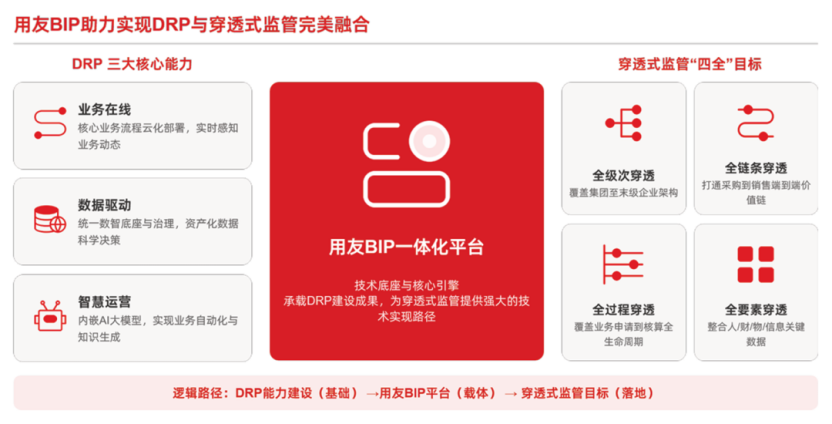
At the current juncture—the inaugural year of the “15th Five-Year Plan” period—the reform of state-owned assets and enterprises is advancing in depth, with the State-owned Assets Supervision and Administration Commission (SASAC) having successively issued major guiding documents that explicitly designate DRP system development and penetrating supervision as core tasks in the reform and development of central and state-owned enterprises. These policies require the construction of an intelligent supervision system encompassing “all levels, all chains, all elements, and all processes,” thereby driving the upgrade of state-owned asset supervision from post-event verification to a full-cycle model incorporating pre-event early warning, in-event control, and post-event traceability, while facilitating the strategic transformation from “managing enterprises” to “managing capital.”
Against this backdrop, central and state-owned enterprises are generally confronted with challenges including data black boxes, disconnection between finance and business, ineffective penetration, and wasteful investment. The convening of this seminar directly addresses industry pain points and responds to policy concerns, establishing a high-level platform for exchange and achievement sharing that assists these enterprises in resolving transformation challenges and fulfilling regulatory requirements.
Mr. Ye Kangtao, Deputy Secretary of the Party Committee and Dean of the Beijing National Accounting Institute, attended the seminar and delivered an opening address. Grounded in the broader context of national strategy and state-owned asset reform, he articulated the contemporary significance of digital and intelligent transformation and penetrating supervision. He noted that establishing a digital, intelligent, and penetrating supervision system is not only an inevitable choice for central and state-owned enterprises in achieving governance modernisation, but also a crucial responsibility for these enterprises to fulfil their missions and safeguard the security of state-owned assets.
Mr. Du Yu, Senior Vice President of Yonyou Network and President of its High-End Business Group, delivered a keynote address focusing on industry pain points and technological innovation pathways, sharing Yonyou’s strategic thinking and practical experience in empowering the transformation of central and state-owned enterprises.
He stated that SASAC’s policies on financial digital and intelligent transformation and penetrating supervision have entered a critical phase of systematic implementation and comprehensive advancement, with numerous central and state-owned enterprises already taking active steps. Nevertheless, he acknowledged that significant bottlenecks and challenges remain to be resolved throughout this process. These challenges ultimately converge on a single proposition: how to translate policy requirements into actionable digital and intelligent capabilities through a platform that is genuinely suited to DRP development requirements and deeply aligned with the core scenarios of penetrating supervision.
With 38 years of deep engagement in enterprise services, Yonyou has consistently remained aligned with the needs of central and state-owned enterprises. Powered by YonBIP and built on a natively integrated “AI × Data × Process” architecture, it has achieved a generational leap beyond traditional ERP, establishing itself as the preferred platform for DRP development and penetrating supervision implementation in these enterprises. Its penetrating supervision platform provides robust assurance for translating policy requirements into implementable digital and intelligent capabilities.
02 YonBIP: The Optimal Paradigm for DRP and Penetrating Supervision Implementation
The White Paper on DRP and Penetrating Supervision for Central and State-Owned Enterprises, jointly compiled by Yonyou and the Beijing National Accounting Institute through in-depth interpretation of core SASAC policies, systematic review of over one hundred practical case studies from central and state-owned enterprises, and assessment of cutting-edge digital and intelligent technology trends, offers a combination of policy guidance, operational practicality, and industry foresight.
The White Paper articulates the core logic of “integrating substance with function, driven by dual engines” between DRP and penetrating supervision.
DRP constitutes the “substance”—a comprehensive digital resource management platform that establishes a full-volume, real-time data resource pool, thereby reinforcing the data foundation for penetrating supervision. Penetrating supervision constitutes the “function”—a risk prevention-oriented approach that, relying on data, penetrates organisational tiers, business operations, and capital flows to achieve precise implementation of supervisory intent. The two are mutually reinforcing and bidirectionally empowering.
Addressing six common misconceptions prevalent in the industry—conceptual, technical, capability, boundary, institutional, and operational—the White Paper precisely analyses the root causes of these issues, explicitly dispelling cognitive biases such as “equating penetration with rigid control,” “prioritising form over substance,” and “emphasising supervision while neglecting empowerment.” It underscores the core principles of balancing control and vitality while reconciling compliance and enablement.
The White Paper proposes a “1-3-4-5” penetrating supervision system framework, encompassing three strategic directions (directly addressing fundamentals, targeted precision, and full-domain coverage); four supporting systems (data governance, model operations, closed-loop rectification, and institutional organisation); and five core capabilities (typical issue traceability, closed-loop risk resolution, full-tier multi-organisation perspective, end-to-end business integration, and the convergence of process, data, and intelligence). It identifies ten key priority areas explicitly mandated by SASAC—including investment, property rights, finance, procurement, and overseas assets—and delineates 11+N categories of risk scenarios covering core risks such as excessive leverage, fraudulent trade, enterprise-entrenched self-dealing, and compensation irregularities, thereby clarifying the focal directions and critical scenarios for penetrating supervision.
YonBIP, as the optimal paradigm for DRP and penetrating supervision implementation, is built on a cloud-native, AI-native, and data-native infrastructure. It establishes an integrated “Five Unifications” system encompassing “data connectivity, tier connectivity, business connectivity, supervisory connectivity, and resolution connectivity,” and possesses six core capabilities: a robust technological foundation, full-domain data governance, end-to-end finance-business integration, deep risk penetration, intelligent model iteration, and closed-loop risk compliance management. It has already developed transformation pathways and achieved practical outcomes for central and state-owned enterprises across various industries and scales.
The release of this White Paper fills a research gap in the domestic field of DRP and penetrating supervision integration. It serves both as a systematic summary of current financial digital and intelligent transformation practices in central and state-owned enterprises and as a scientific projection of future industry development trends. Providing an authoritative reference for government regulatory bodies in optimising policy frameworks, for central and state-owned enterprises in advancing transformation implementation, and for solution providers in innovating their offerings, it holds milestone-level industry significance.
The development of DRP systems and the implementation of penetrating supervision in central and state-owned enterprises constitute a systematic and long-term undertaking, bearing on the value preservation and appreciation of state-owned assets and the broader high-quality development of these enterprises.
Looking forward, Yonyou Network will continue to deepen its engagement in the digital and intelligent transformation of central and state-owned enterprises, persistently advancing technological innovation, solution iteration, and ecosystem co-construction. Supported by the YonBIP platform and guided by the White Paper, it will assist these enterprises in accelerating DRP system development, deepening penetrating supervision implementation, and unlocking the value of AI-driven digital intelligence. In doing so, it will contribute to the modernisation of financial management systems and governance capabilities, lending greater support to the strengthening, expansion, and enhancement of state-owned capital, the accelerated construction of world-class enterprises, and the fulfilment of national strategic priorities.